
Short answer: Good drainage starts with the gradient: a driveway or patio should fall gently away from the house so water runs off rather than pooling. Where water would otherwise reach the house, a garage or the road, a channel drain can catch it and send it to a soakaway or suitable outlet. Permeable surfaces such as permeable block paving, resin-bound and gravel let rain soak through instead. Patios next to the house must also sit low enough below the damp-proof course.
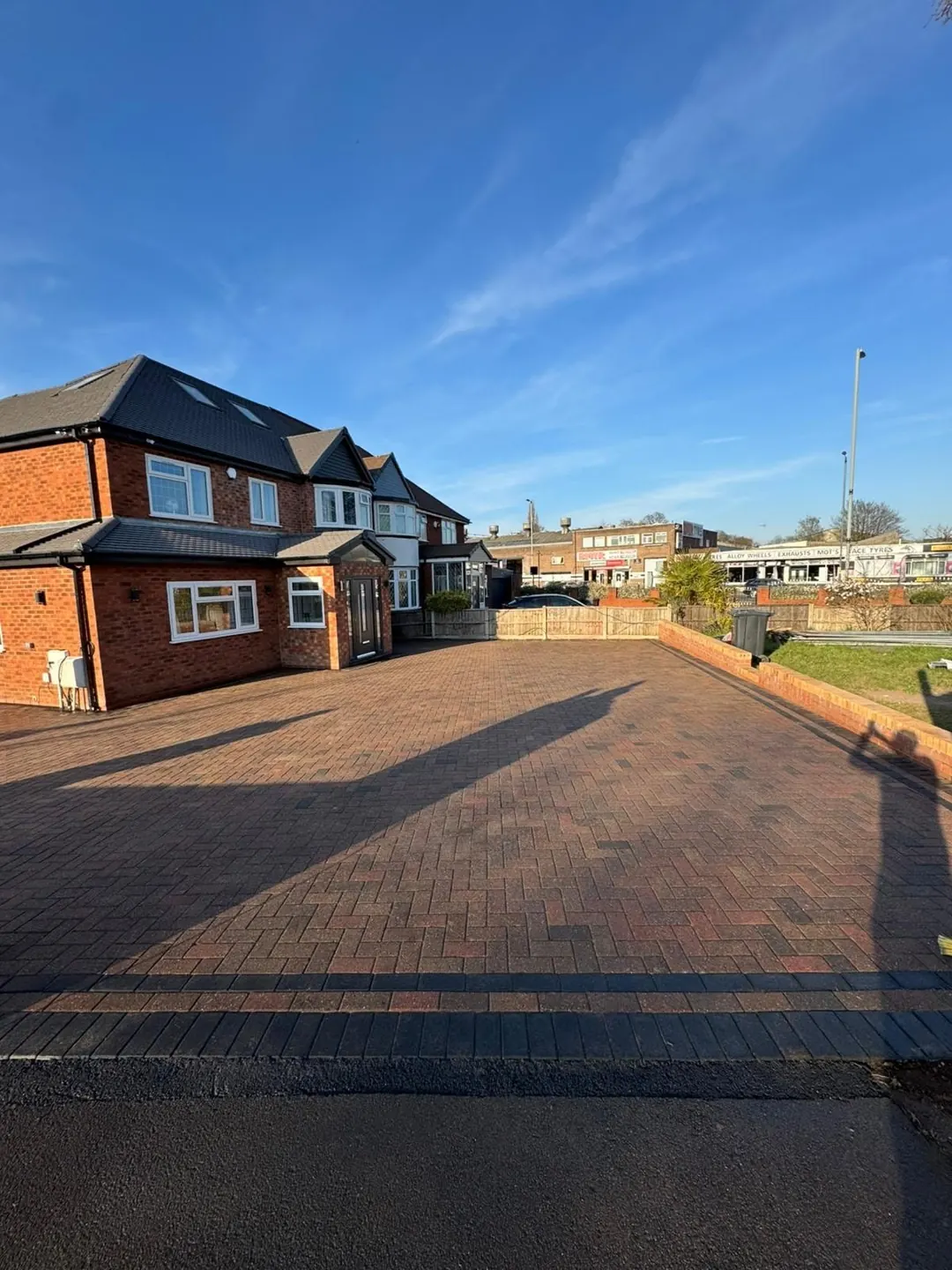
Why drainage matters
Water that sits on a driveway or patio causes more than puddles. Standing water makes surfaces slippery, encourages moss and algae, and stains paving. In winter it can freeze, lifting joints and cracking mortar. Over time, water that soaks into a poorly prepared base softens the ground underneath, which is how ruts and sunken patches appear.
The most serious problems happen where hard surfaces meet the house. If a patio or drive slopes towards the walls, or sits too high against them, rainwater can soak into the brickwork or bridge the damp-proof course and cause damp indoors. Planning drainage before the surface goes down is far cheaper than fixing it afterwards.
Getting the falls right
Every hard surface should have a fall, a slight slope that encourages water to run in a chosen direction. It is gentle enough that you barely notice it when walking, but enough to stop water settling. Paving with a textured surface, like riven stone, generally needs a little more fall than smooth porcelain or tarmac.
The direction matters as much as the slope. Water should run away from buildings towards a lawn, border, gravel strip or drain. On a front drive that slopes down towards the house, the falls have to be worked so that water is collected before it reaches the door or garage. Setting these levels accurately is one of the most important parts of the groundwork.
Channel and linear drains
A channel drain, sometimes called a linear drain, is a long, narrow trough with a grating on top, set flush with the surface. It catches water running across a driveway or patio and carries it away. Channels are often used across the bottom of a sloping drive, in front of a garage door, along a patio beside the house and at a threshold where a door opens onto paving.
A channel is only as good as where it leads. It must connect to a soakaway, a suitable drain or another approved outlet, with pipes laid to a proper fall. Channels also need occasional clearing of leaves and silt so the grating does not block.
Soakaways and where water can go
A soakaway is a pit filled with rubble or, more often now, plastic crates wrapped in a membrane, buried in the ground some distance from buildings. Water piped into it slowly soaks into the surrounding soil. Soakaways work well in free-draining ground but struggle in heavy clay or where the water table is high, so the ground is assessed before relying on one.
Rainwater from a driveway should not normally be connected into the foul sewer, and connecting into a public surface water sewer may need permission from the water company. Letting water run to a lawn or border within your property is often the simplest option where the layout allows.
Permeable options
Permeable surfaces let rain pass through into a specially prepared base below, where it soaks away gradually. Permeable block paving uses blocks with wider joints filled with fine grit rather than sand, laid over an open-graded stone base. Resin-bound surfaces mix stone with resin into a porous layer, and they need a permeable base to work. Gravel is naturally free-draining, especially when laid over a stabilising grid.
These surfaces can remove the need for channels and soakaways on many front drives, though the base design is critical: a permeable top laid over a solid concrete base simply moves the puddle downwards. Our comparison of block paving, resin and tarmac covers looks and upkeep. For front gardens there is also a planning rule about impermeable surfaces, explained in our driveway planning permission guide.
Patios next to the house
A patio laid against the house should finish well below the damp-proof course, the waterproof layer in the wall just above ground level. The generally recommended gap is about 150mm, roughly two brick courses, so that rain splashing off the paving does not reach above it. Air bricks must stay clear and must not be covered or blocked by paving.
Where there is not enough height to achieve that gap, perhaps at a door threshold, a channel drain along the wall and a fall away from the house are used to keep water moving. Our patio and driveway pages explain how we plan levels and drainage as part of each job.
Frequently asked questions
What is a permeable driveway?
One that lets rainwater soak through the surface into a free-draining base, rather than running off. Permeable block paving, resin-bound on a permeable base and gravel are the common options.
Does a new driveway need a drain?
Not always. If it falls towards a lawn or border, or uses a permeable surface and base, a separate drain may not be needed. Drives that slope towards a house or garage usually need a channel drain.
Why is water pooling on my patio?
Usually because the fall is too shallow, in the wrong direction, or slabs have settled. Blocked drains or a base that holds water can also be the cause.
Can drainage be added to an existing driveway?
Often, yes. A channel drain can be cut into the surface and connected to a soakaway or outlet. If the whole drive slopes the wrong way, relaying may be the better long-term fix.
Is gravel a good choice for drainage?
Yes. Gravel drains freely, especially over a stabilising grid and a suitable base. It needs firm edging to keep stones in place and occasional raking and topping up.
Related services
More guides
- How Much Does a New Driveway Cost? What Drives the Price
- How Much Does a Patio Cost? The Factors That Set the Price
- Block Paving vs Resin vs Tarmac: Which Driveway Is Best?
- Do You Need Planning Permission for a Driveway?
- How Long Does a New Driveway or Patio Take to Install?
- Dropped Kerbs: Cost Factors and How to Apply
- Porcelain vs Indian Sandstone Patio: Which Should You Choose?
- How Much Does a Plasterer Charge? What Affects the Price
- Landscaping Cost: What Sets the Price of a Garden Project
- Garden Wall Cost: What Affects the Price of a Brick Wall
- Repointing brickwork: a homeowner's guide
- Retaining walls for sloping gardens
- Planning garden steps and raised patios
- How long does new plaster take to dry?
- All guides
Related guides
- How Much Does a New Driveway Cost? What Drives the Price
- How Much Does a Patio Cost? The Factors That Set the Price
- Block Paving vs Resin vs Tarmac: Which Driveway Is Best?
- Do You Need Planning Permission for a Driveway?